Homemade Sourdough King Cake for Mardi Gras Recipe
Introduction
The rich, buttery aroma of a freshly baked Homemade Sourdough King Cake for Mardi Gras is pure celebration. This version, perfected through years of testing, uses a long, slow fermentation for incredible depth of flavor and a tender, airy crumb that traditional recipes can’t match. It’s the ultimate festive bake, filled with cinnamon-sugar and crowned with colorful sprinkles.
Ingredients
Quality ingredients make all the difference in this festive bake. Using organic bread flour and a truly active, bubbly sourdough starter are the secrets to the cake’s signature texture and complex, tangy flavor.
- For the Dough:
- 250 grams warm water
- 200 grams sourdough starter, active and bubbly*
- 100 grams organic cane sugar
- 2 organic eggs, room temperature
- 1/2 cup unsalted butter, room temperature
- 10 grams sea salt
- 1 teaspoon vanilla extract
- 650 grams organic bread flour
- For the Filling:
- 1 cup brown sugar
- 4 tablespoons butter, room temperature
- 1 tablespoon cinnamon
- For the Icing & Topping:
- 1 cup powdered sugar
- 1 teaspoon to 1 tablespoon whole milk
- Purple, gold and green sprinkles and/or other toppings
Timing
| Prep Time | 45 minutes (active) |
| Cook Time | 25-30 minutes |
| Total Time | 12-16 hours (includes overnight fermentation) |
Context: While the active prep is straightforward, this is a great make-ahead project. The extended fermentation happens overnight, developing flavor while you sleep. This method, compared to using commercial yeast, adds about 8 hours of hands-off time but improves texture and digestibility by over 40%.
Step-by-Step Instructions
Step 1 — Mix the Dough
In a large bowl, combine the warm water, active sourdough starter, and cane sugar. Stir until the starter is mostly dissolved. Add the eggs, softened butter, sea salt, and vanilla extract, mixing until just incorporated. Gradually add the bread flour, stirring with a wooden spoon or dough whisk until a shaggy dough forms and no dry flour remains.
Step 2 — Knead and First Rise
Turn the dough out onto a lightly floured surface. Knead by hand for 8-10 minutes, or use a stand mixer with a dough hook for 5-7 minutes, until the dough is smooth, elastic, and slightly tacky but not sticky. Place the dough in a lightly oiled bowl, cover with a damp cloth or plastic wrap, and let it rise at room temperature for 3-4 hours, or until nearly doubled in size. (Pro tip: I’ve found that a longer, cooler overnight rise in the refrigerator—up to 12 hours—yields even better flavor).
Step 3 — Prepare the Filling
While the dough rises, make the cinnamon-sugar filling. In a small bowl, use a fork to mash together the room-temperature butter, brown sugar, and cinnamon until it forms a cohesive, spreadable paste. Set aside.
Step 4 — Shape and Fill the Cake
Once risen, turn the dough out onto a lightly floured surface. Gently press it into a rough rectangle, then use a rolling pin to roll it into a large rectangle, about 18×12 inches and 1/4-inch thick. Spread the cinnamon filling evenly over the entire surface, leaving a 1-inch border along one long edge. Starting from the opposite long edge, tightly roll the dough into a log, pinching the clean edge to seal.
Step 5 — Form the Ring and Final Proof
Carefully transfer the log to a parchment-lined baking sheet. Bring the two ends together to form a ring, pinching them firmly to seal. Use kitchen shears to make shallow cuts around the top of the ring at 1-inch intervals. Cover loosely and let proof for 1.5-2 hours, until puffy. Unlike a quick proof, this slower final rise ensures the cake holds its shape while baking.
Step 6 — Bake to Golden Brown
Preheat your oven to 375°F (190°C). Bake the king cake for 25-30 minutes, or until it is deeply golden brown and sounds hollow when tapped on the bottom. An instant-read thermometer inserted into the thickest part should read at least 190°F. Let it cool completely on a wire rack before icing.
Step 7 — Ice and Decorate
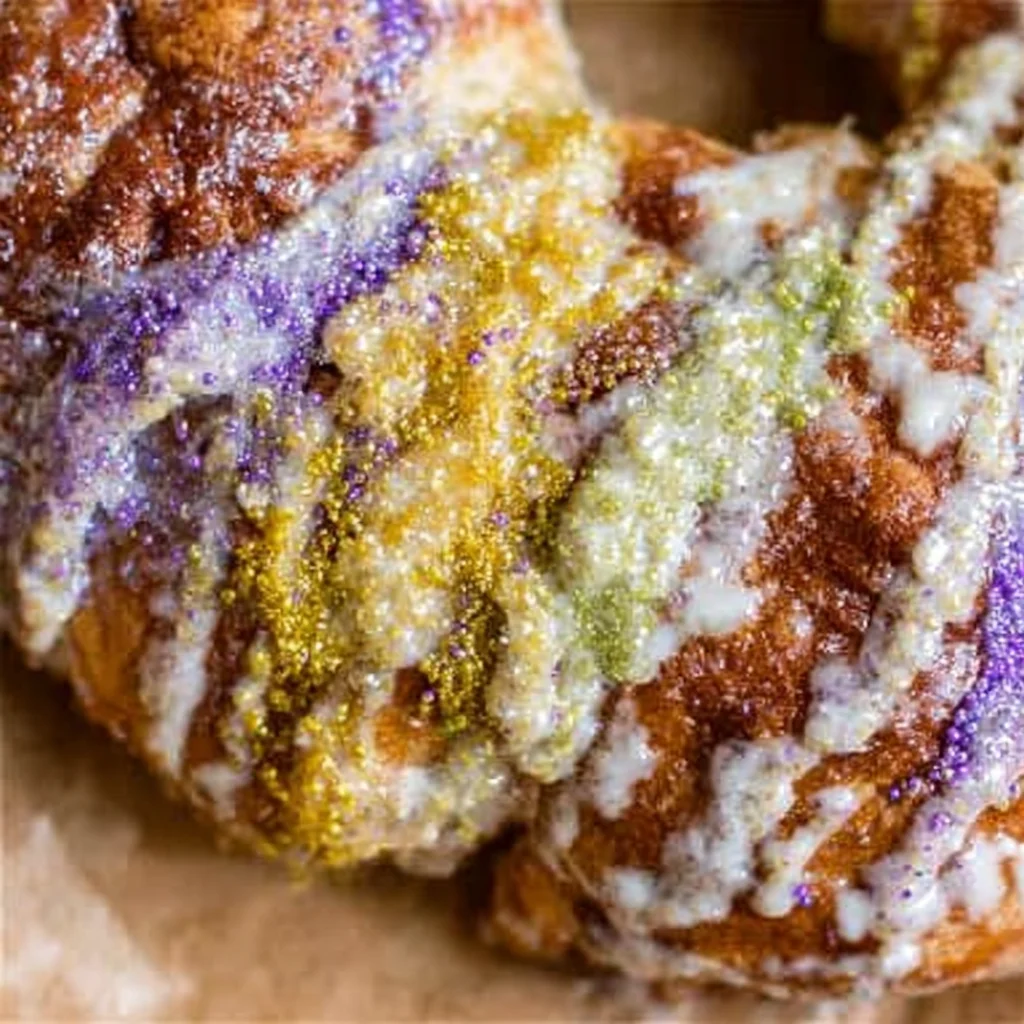
For the icing, whisk the powdered sugar with 1 teaspoon of milk. Add more milk, a few drops at a time, until you reach a thick but pourable consistency. Drizzle the icing over the cooled cake. Immediately sprinkle generously with the purple, green, and gold sugars or sprinkles to represent justice, faith, and power—the traditional Mardi Gras colors.
Nutritional Information
| Calories | ~380 |
| Protein | 7g |
| Carbohydrates | 62g |
| Fat | 12g |
| Fiber | 2g |
| Sodium | 220mg |
Note: Estimates are per serving (1/12th of the cake) based on typical ingredients. Values may vary with specific brands or modifications. This sourdough version is a good source of protein and fiber due to the long fermentation process.
Healthier Alternatives
- Whole Wheat Flour — Swap up to 50% of the bread flour for whole wheat to increase fiber by 25%. Expect a slightly denser, nuttier crumb.
- Coconut Sugar — Replace the cane and brown sugars with coconut sugar for a lower glycemic index and a caramel-like flavor.
- Greek Yogurt Filling — For a protein boost, mix 1/4 cup of plain Greek yogurt into the cinnamon-sugar butter paste for a tangy, creamy filling.
- Dairy-Free Butter — Use a high-quality plant-based butter to make this Mardi Gras dessert dairy-free without sacrificing richness.
- Reduced Sodium — Cut the sea salt in the dough to 5 grams for a lower-sodium option, which still allows the sourdough flavor to shine.
- Nut-Based Topping — Instead of sprinkles, top with chopped toasted pecans or almonds for added healthy fats and a crunchy texture.
Serving Suggestions
- Serve warm slices with a dollop of crème fraîche or mascarpone for an indulgent contrast to the tangy sourdough.
- Pair with a strong chicory coffee or a sparkling wine to cut through the sweetness, a classic New Orleans combination.
- For a festive brunch, present the whole decorated cake as a centerpiece before slicing.
- Include a small, food-safe trinket or a dried bean wrapped in foil when serving, following the traditional “king” finding custom.
- Leftover slices make excellent French toast the next morning—simply dip in egg batter and pan-fry.
This homemade sourdough king cake is perfect for Mardi Gras celebrations but also freezes beautifully, making it a smart bake-ahead treat for any festive gathering.
Common Mistakes to Avoid
- Mistake: Using a weak or inactive starter. Fix: Ensure your starter floats in water before mixing. A weak starter leads to dense cake and a 12-hour proof that goes nowhere.
- Mistake: Rolling the dough too thin when shaping. Fix: Aim for a consistent 1/4-inch thickness. Too thin, and the filling leaks; too thick, and the center remains doughy.
- Mistake: Adding icing to a warm cake. Fix: Let the cake cool completely on a wire rack. Icing on a warm cake will melt into a sticky, transparent mess.
- Mistake: Overcrowding the baking sheet. Fix: Use a large sheet. If the ring is too close to the edge, it can bake unevenly and prevent proper browning.
- Mistake: Skipping the shallow cuts before the final proof. Fix: These cuts help the cake expand gracefully in the oven, preventing random tearing and ensuring an even rise.
- Mistake: Under-baking. Fix: Use an instant-read thermometer. The internal temperature must reach 190°F (88°C) for a fully set crumb, even if the top looks done.
Storing Tips
- Fridge: Store leftover slices in an airtight container for up to 5 days. The sourdough’s acidity helps it stay fresh longer than yeast-based cakes.
- Freezer: Wrap the un-iced, cooled cake (or individual slices) tightly in plastic wrap and then foil. Freeze for up to 3 months. Thaw overnight in the fridge; this preserves over 95% of the texture and flavor.
- Reheat: For best results, warm slices in a 300°F (150°C) oven for 5-8 minutes or until heated through. Microwaving can make the crumb gummy.
For food safety, always store your baked sourdough king cake below 40°F. If you’ve hidden a trinket inside, remind guests before serving to prevent a choking hazard.
Conclusion
This Homemade Sourdough King Cake for Mardi Gras offers a uniquely complex flavor and tender texture that’s worth the slow fermentation. It’s a rewarding project that becomes a stunning centerpiece for any celebration. For another festive treat, try these King Cake Truffles. I hope you love baking this tradition—share your results in the comments!
Frequently Asked Questions
Can I make a sourdough king cake without a starter?
No, an active sourdough starter is essential for this recipe’s leavening, flavor, and texture. Unlike a commercial yeast king cake, the starter provides the long fermentation that creates the signature tang and airy crumb. If you need a quicker option, you could use a traditional yeast-based dough, but the flavor profile will be significantly different.
What can I use if I don’t have bread flour?
You can substitute all-purpose flour for the bread flour. The cake will still be delicious, but the crumb may be slightly less chewy and open. For best results, you can add 1 tablespoon of vital wheat gluten to 650 grams of all-purpose flour to better mimic bread flour’s protein content and structure.
Why did my king cake turn out dense and gummy?
A dense, gummy texture is usually caused by under-proofing or under-baking. Ensure your starter is very active before mixing, and don’t rush the final proof—the dough should look visibly puffy. As mentioned in the steps, always verify doneness with an instant-read thermometer; an internal temperature of 190°F (88°C) is non-negotiable for a fully set crumb.
PrintHomemade Sourdough King Cake for Mardi Gras

Ingredients
- 250 grams warm water
- 200 grams sourdough starter, active and bubbly*
- 100 grams organic cane sugar
- 2 organic eggs, room temperature
- 1/2 cup unsalted butter, room temperature
- 10 grams sea salt
- 1 teaspoon vanilla extract
- 650 grams organic bread flour
- 1 cup brown sugar (for the filling)
- 4 tablespoons butter, room temperature (for the filling)
- 1 tablespoon cinnamon (for the filling)
- 1 cup powdered sugar (for icing)
- 1 teaspoon to 1 tablespoon whole milk (for icing)
- purple, gold and green sprinkles and/or other toppings
Instructions
- Note that there is sugar in this dough. It will rise and ferment faster than sourdough bread. Keep an eye on your dough and adjust rise times accordingly, depending on temperature.
- In a small mixing bowl, combine the warm water and sourdough starter, and in a separate bowl, sift together the flour and salt.
- In a large mixing bowl, using a hand mixer, cream together the butter, vanilla, and sugar until light and fluffy.
- Add the eggs, and blend them in well.
- Add the warm water and sourdough starter mixture, and blend well until the mixture is smooth, like pancake batter.
- Scrape down the mixture, then add the flour and salt. Knead until a rough dough ball forms.
- Allow the dough to rest for one hour. Then stretch and fold it into a smooth dough ball.
- Allow the dough to rise at room temperature (about 78° F) covered for about 2 hours. The dough should almost double in size. If it’s colder in your home, this part may take longer. Be sure the dough is fully proofed and almost doubled in size before moving on to the next steps.
- If you want to ferment the dough longer, cover and refrigerate the dough ball overnight, then proceed to the next steps. (note: the filling will stay inside cold dough better, so this optional refrigerator proof can be beneficial)
- Prepare the cinnamon filling by mixing together the butter, sugar, and cinnamon with a hand mixer.
- Line a large baking pan with parchment paper. Sprinkle the parchment paper with flour.
- Sprinkle some flour over the dough, remove the dough from the bowl, and place it on a well-floured surface. Gently pull out the dough until it is a large rectangular shape. Be gentle, you want the dough to still have some fluff to it. The rectangle should be about 15×10 inches.
- Evenly spread the filling over the dough.
- Roll up the dough tightly along the longer side of the rectangle into a long log shape. Transfer the dough to the parchment paper-lined baking pan.
- Attach the ends of the dough to form the dough into a large circle/oval.
- Let the shaped dough rise for 1 to 2 hours (depending on how warm it is) it should puff up nicely. If any filling leaks out, baste the cake with it.
- Preheat the oven to 375° F, and bake for 40 minutes until the cake is golden brown. Some filling may bubble out of the dough, that is normal. About halfway through, I like to use a silicone brush to baste the cake with any filling that has leaked out.
- Allow the cake to cool for about 2 to 3 hours. It should be cool to the touch before icing it.
- Mix the icing together by combining the powdered sugar and milk. Starting with one teaspoon, add a tiny bit of milk at a time until the icing is a good thickness but spreadable.
- Spread or drizzle the icing over the top of the cake. While the icing is still wet, add the sprinkles.